
California ADU Laws
California ADU law, explained for 2026.
A plain-language, current guide to how many ADUs you can build, on a single-family lot or an existing multifamily property. It reflects the 2024 to 2026 legislative changes, including SB 477's recodification into a new Chapter 13, and 2026's SB 543 and AB 1154. For the full legal detail, use the deep-dive pages for single-family and multifamily below.
Quick Answer
Current as of July 2026How many ADUs can you build in California?
Here is the direct answer, with the nuance that usually gets left out elsewhere online.
On a single-family lot
A single-family lot must be allowed up to three accessory units at once: one conversion ADU built from existing space, one Junior ADU (JADU) up to 500 square feet, and one new detached ADU up to 800 square feet on the fastest, no-review track. There is no owner-occupancy requirement for the ADU itself, and the city must decide a complete application within 60 days or it is automatically approved.
Full single-family law detailOn an existing multifamily property
An existing multifamily property can add up to eight new detached ADUs, but that number is capped at the number of housing units already on the lot (a 4-unit building can add up to 4, not 8, while an 8-unit-or-larger building can reach the full 8; a proposed-but-not-yet-built building is capped at 2). Separately, and stackable with those detached units, owners can also convert non-livable interior space, basements, storage rooms, parking garages, and similar areas, into ADUs, up to 25% of the existing unit count.
Full multifamily law detailSingle-Family
Single-Family ADU Rules
Every rule below applies statewide, as of right. Your city cannot send you to a discretionary hearing or deny you outright for meeting them. A city is free to be more generous than these minimums, but none can be more restrictive.
Up to three ADUs on one lot
California requires every single-family lot to allow up to three accessory units at the same time, and it is a specific combination, not any three units of your choosing:
- One conversion ADU, created from existing space inside the home or an accessory structure such as a garage.
- One Junior ADU (JADU), up to 500 square feet, built within the walls of the existing house or its attached garage. Only one JADU is allowed per lot.
- One new detached ADU, up to 800 square feet, on the fastest track available, the one that does not require discretionary review.
That is the combination the state guarantees everywhere. Outside of it, state law also sets a separate, larger size ceiling for a detached ADU built on its own, covered next.
How big can it be
Detached ADU
The statewide default maximum is 1,200 square feet. A city can set its own cap, but state law puts a floor under how low that cap can go: not below 850 square feet, or 1,000 square feet for an ADU with two or more bedrooms.
JADU
Capped at 500 square feet, and it has to be built inside the existing house's walls or its attached garage, not as new detached square footage. One JADU per lot.
New in 2026: SB 543 confirms that the 800-square-foot figure on the no-review track counts interior livable space only, so exterior walls and stairs do not eat into it.
Setbacks
A city can require a side or rear setback of up to 4 feet for an ADU, and no more. If the ADU is built within an existing structure, or rebuilt within that structure's existing footprint, the required setback drops to 0 feet.
Parking
At most, a city can require 1 parking space per ADU, or per bedroom, whichever is fewer. State law goes further: in six specific situations, a city cannot require any ADU parking at all. Three of the most common:
Near public transit
The lot is within half a mile of a bus or rail stop.
Historic districts
The property sits in a designated historic district.
Converting a structure
The ADU is created by converting an existing structure, like a garage.
As of AB 1154 (2026), a city also cannot impose any parking requirement on an ADU of 500 square feet or less. And if building the ADU means removing a garage, carport, or other covered parking space, the city can never require you to replace it.
No owner-occupancy requirement
You do not have to live on the property to build or own an ADU, on any lot. That protection is permanent, as of AB 976 (2023). The one remaining exception is the JADU: it can carry an owner-occupancy requirement only if it shares a bathroom with the main house. As of AB 1154 (2026), a JADU with its own bathroom no longer triggers one at all.
The 60-day approval clock
Once you submit a complete ADU application, your city must approve or deny it within 60 days, or it is automatically deemed approved. New as of 2026, SB 543 adds a completeness check first: cities must confirm within 15 days whether your submittal is complete, give you a written list of anything missing, and on resubmittal may only review the items they already flagged.
Two-story ADUs
Two-story ADUs are allowed statewide. Height caps run 16 to 18 feet for a detached ADU, and up to 25 feet for an ADU attached to the primary home.
Beyond ADUs: SB 9 lot splits
A separate 2021 law, SB 9 (the HOME Act), is the other big lever on a single-family lot. It lets you add a second primary home, or split the lot in two, ministerially, and combined with ADUs it can bring a single parcel up to as many as four homes. It remains in effect for general-law cities, with its application to charter cities still in litigation.
(Not the unrelated 2025 bill also numbered SB 9, which only governs ADU-ordinance filing.) See the full SB 9 breakdown.
Multifamily & Densification
Multifamily ADU & Densification Rules
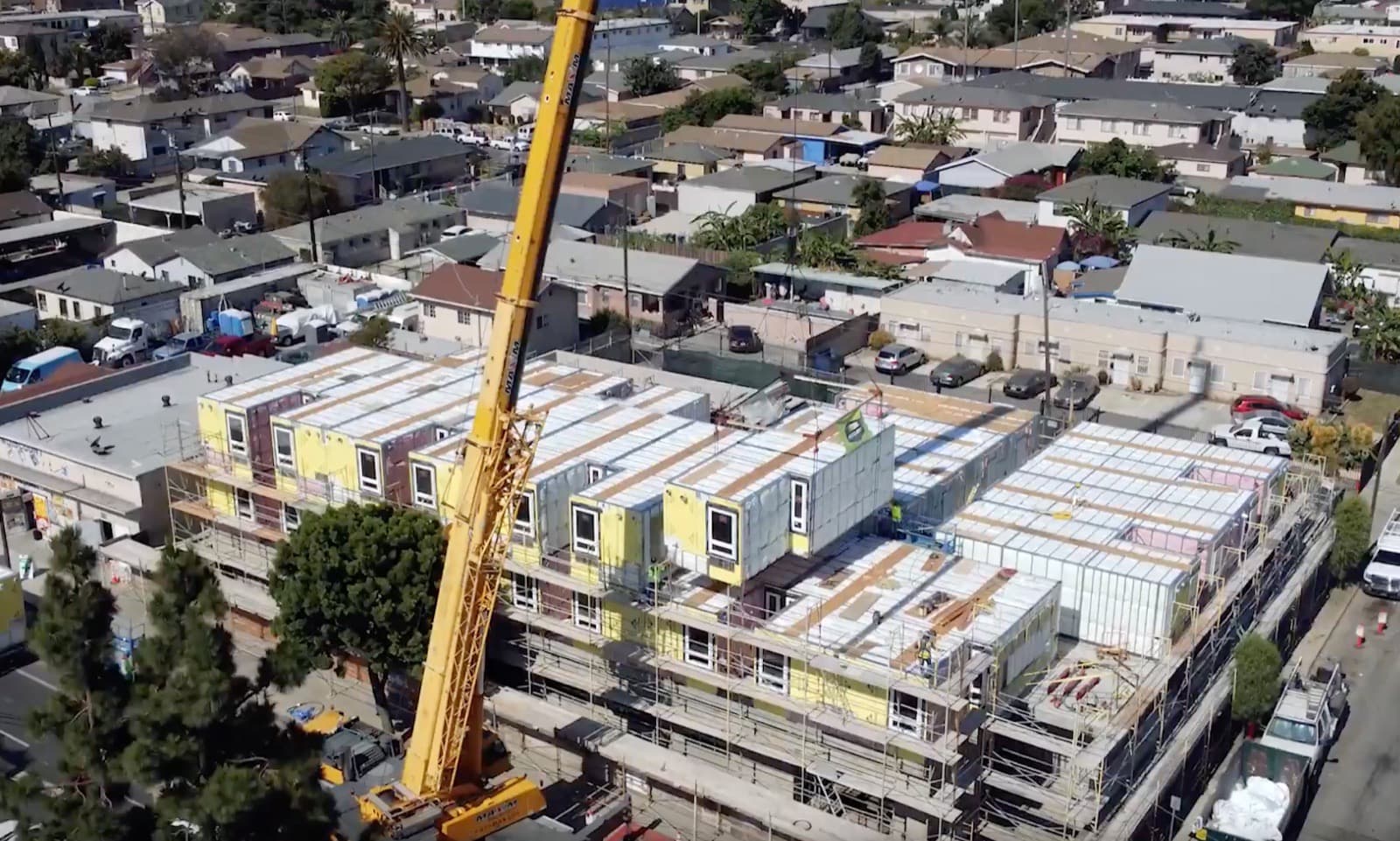
This is where ADU Concepts specializes, and where the internet gets California law wrong most often. An existing apartment or condo building has two separate, stackable ways to add units, without a full new-building entitlement process.
Track 1: up to 8 new detached ADUs
Under SB 1211 (effective 2025), a city must allow an existing multifamily property to add new, freestanding detached ADUs, up to 8 of them. The number is capped at how many housing units are already on the lot, it is not a flat 8 for every property:
| Multifamily property status | Detached ADUs allowed |
|---|---|
| Existing building, 1 to 7 units | Up to the same number of units already on the lot (example: a 4-unit building can add up to 4) |
| Existing building, 8 or more units | Up to 8 detached ADUs |
| Multifamily building only proposed, not yet built | Up to 2 detached ADUs |
Treat any claim that a multifamily property automatically gets 8 ADUs as incomplete. Ask us to run the actual number for your building.
Track 2: convert non-livable space, up to 25% of existing units
Separately from Track 1, and stackable with it on the same property, multifamily owners can convert existing non-livable interior space, basements, storage rooms, boiler rooms, parking garages and carports, even a leasing office, into ADUs. The limit is 25% of the existing number of units on the property, with a minimum of 1 conversion allowed even if 25% of your unit count rounds down to zero.
Because the two tracks are separate, they stack. An existing 8-unit building, for example, could pursue up to 8 new detached ADUs under Track 1, plus up to 2 more units through interior conversion under Track 2 (25% of 8), as many as 10 additional units on one lot, without a new-building entitlement process.
Same setback and height rules
Detached ADUs on a multifamily lot follow the same limits as single-family detached ADUs: up to a 4-foot side or rear setback (0 feet if built within an existing structure's footprint), and the same two-story height allowance described above. SB 1211 also bars cities from making you replace parking removed to build them.
No JADUs on multifamily lots
Junior ADUs are a single-family-only tool. JADU law does not extend to multifamily properties, so a densification plan runs entirely on the two tracks above: new detached ADUs and interior conversions.
Recent Law Changes
What changed, 2023 to 2026
California's ADU law has moved fast over the last few years. This is the short version of what actually changed, in order, with a link to each bill's official text.
- 2023AB 976Operative statewide
Owner-occupancy requirement removed, permanently
California permanently eliminated the owner-occupancy requirement for ADUs, removing the sunset that would have let it return. The one narrow carve-out lives on in the JADU rules, covered by AB 1154 below.
Read AB 976 - 2023AB 1033Local opt-in
ADU-as-condo becomes a local option
Cities were given the option to let an ADU be sold separately from the primary home, like a condominium, through their own ordinance (now Gov. Code § 66342). It is not a statewide right; only a handful of California cities have opted in so far.
Read AB 1033 - 2024SB 477Effective January 1, 2025
ADU law recodified into a new Chapter 13
The old ADU statute, Government Code Sections 65852.2 and 65852.22, was repealed and replaced with a new Chapter 13, Government Code Sections 66310 through 66342. Older articles citing the old section numbers are describing an outdated citation, not an outdated right.
Read SB 477 - 2025SB 1211Effective January 1, 2025
The multifamily densification rule takes effect
Existing multifamily properties gained the right to add up to 8 new detached ADUs, capped at the number of housing units already on the lot, and cities can no longer force owners to replace parking removed to make room for them.
Read SB 1211 - 2025AB 462Urgency statute, effective October 15, 2025
Faster occupancy for fire rebuilds, plus a coastal clock
Two things at once. A local agency can now issue a certificate of occupancy for an ADU before the fire-damaged primary home on the same lot receives its own, on lots in a county under a Governor's disaster declaration dated on or after February 1, 2025, including Eaton and Palisades rebuild lots. Separately, cities must now approve or deny a coastal development permit for an ADU within 60 days, and Coastal Commission appeals of those permits are removed.
Read AB 462 - 2026SB 543Effective January 1, 2026
A 15-day completeness check, and a tighter approval clock
Cities must confirm within 15 days whether an ADU application is complete, give a written list of anything missing, and on resubmittal may only review items they already flagged. If they miss the 60-day decision window, the ADU is deemed approved. SB 543 also clarifies that the 800-square-foot cap counts interior livable space only, not exterior walls or stairs.
Read SB 543 - 2026AB 1154Effective January 1, 2026
JADU owner-occupancy narrowed further
The owner-occupancy requirement now applies to a Junior ADU only if it shares a bathroom with the main house. A JADU with its own bathroom no longer triggers it. AB 1154 also sets a 30-day minimum rental term for JADUs (no short-term rentals) and bars cities from imposing parking standards on any ADU of 500 square feet or less.
Read AB 1154 - 2026SB 9Effective January 1, 2026
Local ADU ordinances must be filed with HCD, or they are void
If a city fails to submit a new or amended ADU ordinance to the state (HCD) within 60 days of adopting it, or fails to fix a noncompliance finding within 30 days, that ordinance becomes null and void, and the state's default ADU rules apply in its place. This is a 2025 bill distinct from the 2021 SB 9 lot-split law.
Read SB 9
Official Sources
Do not take our word for it.
Everything on this page traces back to California statute and state guidance. Here is where to read the law yourself, straight from the source.
Straight Talk
Funding, coastal lots, and how local rules actually work
CalHFA's ADU grant: not currently funded
You may have read that California offers a $40,000 grant toward ADU pre-development costs through CalHFA. That program has previously offered grants, but as of this writing its funding has been exhausted. We won't tell you money is available when it isn't, ask us about current financing and incentive options when you're ready to move forward.
Coastal lots got faster in 2025
AB 462 now requires a coastal development permit for an ADU to be approved or denied within 60 days and removes Coastal Commission appeals of those permits. Some jurisdictions, including much of Los Angeles County, exempt ADUs from the coastal permit entirely. We confirm the coastal status of your address before you plan.
Local rules: more permissive, never more restrictive
A city can adopt ADU rules friendlier than the state minimums, but none can be more restrictive. As of SB 9 (2025), a local ordinance that a city fails to file with the state is void, and the state defaults apply instead. Every city still runs its own process. Our permitting team navigates each one for you, across Los Angeles, Ventura, and Orange counties.
FAQ
Frequently asked questions
How many ADUs can a single-family lot have in California?
Up to three at once: one conversion ADU built from existing space, one Junior ADU (JADU) up to 500 square feet, and one new detached ADU up to 800 square feet on the fastest, no-review track. A larger detached ADU, up to 1,200 square feet by default, is allowed under the standard ministerial process.
How big can a detached ADU be in California?
The statewide default maximum is 1,200 square feet. A city can set its own cap, but state law does not let it go below 850 square feet, or 1,000 square feet for an ADU with two or more bedrooms. As of SB 543 (2026), the 800-square-foot figure used for the no-review track counts interior livable space only, not exterior walls or stairs.
Do I have to live in my house to build an ADU?
No. As of AB 976 (2023), California permanently removed the owner-occupancy requirement for ADUs. The one remaining exception is a JADU that shares a bathroom with the main house. As of AB 1154 (2026), a JADU with its own bathroom no longer triggers any owner-occupancy requirement at all.
How long does the city have to approve my ADU application?
Once your application is complete, the city has 60 days to approve or deny it, or it is automatically approved. As of SB 543 (2026), cities also have 15 days up front to confirm whether your application is complete, must give you a written list of anything missing, and on resubmittal may only review the items they already flagged.
How many ADUs can I add to an existing multifamily property?
Under SB 1211, up to 8 new detached ADUs, but capped at the number of units already on the property, not a flat 8 for every building. A 4-unit building can add up to 4; an 8-unit-or-larger building can add the full 8. A multifamily building that is only proposed, not yet built, is capped at 2.
Can I convert a garage, basement, or storage room in my apartment building into an ADU?
Yes. Separately from the detached-ADU rule above, and stackable with it, multifamily owners can convert non-livable interior space, basements, storage rooms, boiler rooms, parking garages and carports, even a leasing office, into ADUs, up to 25% of the existing unit count, with a minimum of 1 conversion allowed.
Can I sell my ADU separately, like a condo?
Only in cities that have opted in. AB 1033 (2023) lets a city allow ADU condo sales through its own ordinance, but it is not a statewide right, and only a handful of California cities have adopted it so far. Ask us whether your city currently allows it.
Do the coastal zone rules slow an ADU down?
Less than they used to. AB 462 (effective October 2025) now requires a coastal development permit for an ADU to be approved or denied within 60 days and removes Coastal Commission appeals of those permits. Some jurisdictions, including much of Los Angeles County, exempt ADUs from the coastal permit entirely. We confirm the coastal status of your specific address before you plan.
Is the $40,000 CalHFA ADU grant still available?
Not currently. CalHFA has previously offered ADU grants, but that funding has been exhausted as of this writing. Ask us about current financing and incentive options when you are ready to move forward.
This page is general information based on California state law, current as of July 2026 and cross-checked against HCD's 2026 ADU Handbook. Local ordinances vary and can add requirements on top of what's described here, and this isn't legal advice. Confirm the specifics for your address before you plan or permit a project, our permitting team is happy to walk you through it.
Free ADU evaluation
Let's find out what your lot, or your building, actually allows.
State law sets the floor. Your city adds its own process on top. Tell us about your property and our permitting team will tell you honestly what fits, and what it takes to get there.
Single-Family ADU Law
The full legal detail for your own home: the three-unit combination, JADUs, sizes, setbacks, and parking.
Learn moreMultifamily ADU Law
The full densification playbook: SB 1211 detached ADUs plus interior conversions, and how they stack.
Learn moreBrowse All Layouts
See the pre-engineered layouts we design, permit, and build.
Learn more