
Single-Family ADU Law
Single-family ADU law in California, in depth.
Everything the state guarantees on a single-family lot: the three-unit combination, the JADU rules after AB 1154, and the size, setback, parking, and approval limits your city cannot exceed. Written in plain language, current for 2026.
At a glance
Current as of July 2026Up to 3
accessory units on one single-family lot
1,200 sq ft
default max for a detached ADU
4 ft
the most a city can require for a side or rear setback
60 days
to approve a complete application, or it is deemed approved
The core rule
Three doors on one single-family lot.
California requires most single-family lots to allow up to three accessory units at once. It is a specific combination, not any three units of your choosing.
One conversion ADU
Created from existing space inside the home or an accessory structure, most often a garage conversion. Because the structure already stands, this is usually the fastest and least expensive path to a rentable unit.
One Junior ADU (JADU)
Up to 500 square feet, carved out inside the walls of the existing house or its attached garage. It needs its own entrance and an efficiency kitchen, and it may share a bathroom with the main house. One JADU per lot.
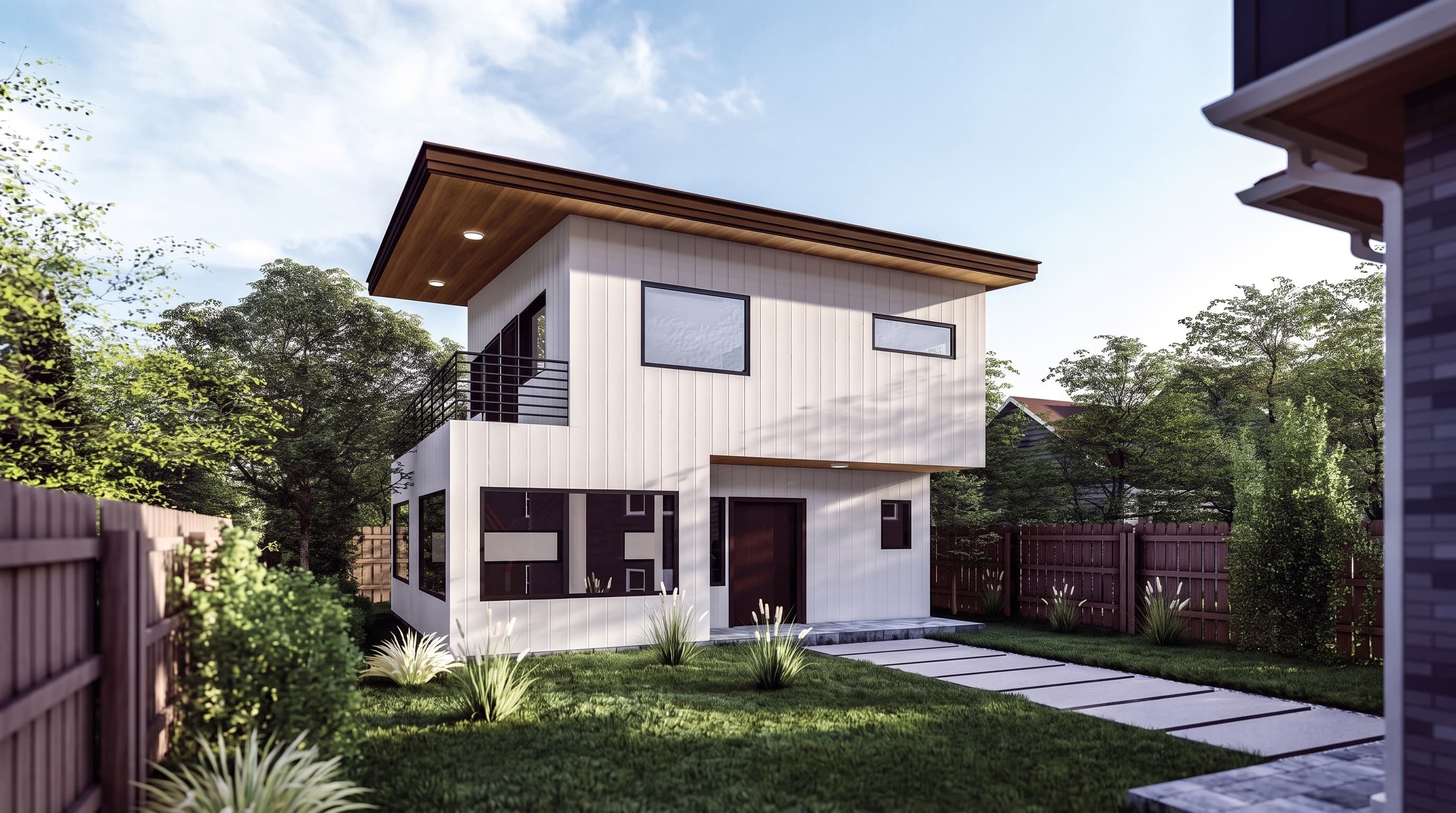
One new detached ADU
A freestanding new structure, up to 800 square feet on the fastest no-review track. Build it larger, up to the 1,200 sq ft default, and it still qualifies under the standard ministerial process, just outside the guaranteed no-review lane.
The three-unit combination is the floor the state guarantees everywhere. A garage conversion plus a JADU inside the house plus a new backyard ADU is the classic full build-out. Not every lot fits all three after setbacks and site work, which is exactly what a feasibility review sorts out before you spend on design.
Beyond the ADU rules
SB 9: split the lot, or add a second home
SB 9, California's 2021 HOME Act, is a separate law from the ADU rules above, but it is the other big lever on a single-family lot. It lets you add a second primary home, or divide the lot in two, through the same ministerial, no-hearing process. Used together with ADUs, it can take one single-family parcel up to as many as four homes.
Not to be confused with the unrelated 2025 bill also numbered SB 9, which only governs how cities file their ADU ordinances with the state.
Move 1: add a duplex, no split
On a single-family lot, SB 9 lets you build up to two primary units without dividing the property. Keep the lot whole and add a second home. This path carries no owner-occupancy requirement.
Move 2: split the lot in two
An urban lot split divides one lot into two. Each new lot generally must be at least 1,200 square feet, and neither can be smaller than 40% of the original. You can then put up to two units on each lot, up to four total. A lot split requires you to sign an affidavit that you will live in one unit as your primary residence for at least three years.
What can make a lot ineligible
SB 9 is ministerial, but it does not apply to every lot. A parcel is generally excluded when:
- It has a unit that is rent-controlled, deed-restricted as affordable, or that a tenant has occupied in the last three years.
- It sits in a designated historic district, or is a registered historic property.
- It is in a high fire, flood, or other hazard zone, or on prime farmland, wetlands, or conservation land, unless the project meets the required mitigation.
- The project would require demolishing more than 25% of an existing home's exterior walls, where the city has adopted that limit.
How SB 9 stacks with ADUs
The two laws interact, and the details are where people get tripped up:
- Without a lot split: an SB 9 duplex can often be paired with ADUs, and depending on your city the total can reach several units on the undivided lot.
- With a lot split: each resulting lot is capped at two units, counting any ADU, for a hard ceiling of four homes across the original parcel.
As a rule of thumb, SB 9 and ADU law together cannot exceed four units on a lot that was zoned single-family. The exact mix that works on your lot is a feasibility question, and it is one we answer before you commit to a design.
Strengthened by SB 450 (2025)
SB 450 put SB 9 projects on a 60-day ministerial clock and held cities to objective standards only, so long as those standards do not physically preclude two units of at least 800 square feet each.
Current legal status, honestly
SB 9 is in effect for general-law cities. Its application to charter cities is being litigated: a trial court sided with five charter cities (Redondo Beach, Carson, Torrance, Whittier, and Del Mar), and the state's appeal is pending as of 2026 in City of Redondo Beach v. Bonta. We confirm exactly where your city stands before you count on it.
JADU Deep Dive
The Junior ADU, and what changed in 2026
The JADU is the most misunderstood unit in the single-family combination, and the one AB 1154 just reshaped. Here is exactly how it works.
What a JADU is
- Up to 500 square feet, built inside the existing walls of the home or its attached garage.
- Needs its own exterior entrance and an efficiency kitchen (a compact kitchen, not a full one).
- May share a bathroom with the main house, which is what makes it cheaper to build.
- One per lot, and it is a single-family-only tool. Multifamily properties do not get JADUs.
Owner-occupancy, narrowed by AB 1154
Historically a JADU always carried an owner-occupancy requirement: the owner had to live in either the JADU or the main house. AB 1154 (effective January 1, 2026) narrows that. Now the requirement applies only if the JADU shares a bathroom with the main house. Give the JADU its own bathroom and there is no owner-occupancy requirement at all.
Rental term: 30 days and up
AB 1154 also sets a 30-day minimum rental term for JADUs, which rules out Airbnb-style short-term rentals. If your plan is nightly-rental income, a JADU is not the vehicle for it.
No parking for a JADU
A city cannot require any parking for a JADU. And under AB 1154, that no-parking protection now extends to any ADU of 500 square feet or less, JADU or not.
Size limits
How big each unit can be
Cities can set their own size caps, but state law puts hard floors underneath them. A city can be more generous than the numbers below, never more restrictive.
| Unit type | Size | The nuance |
|---|---|---|
| Detached ADU (default) | 1,200 sq ft | Statewide default. A city can set its own cap but not below the floors at right. |
| City's minimum allowed cap | 850 / 1,000 sq ft | A city cannot cap a detached ADU below 850 sq ft, or 1,000 sq ft for 2+ bedrooms. |
| No-review track detached ADU | 800 sq ft | SB 543 (2026): counts interior livable space only, not exterior walls or stairs. |
| Attached ADU | Up to 50% of the home | A city may limit an attached ADU to half the primary home's size, but never below the 850 / 1,000 floors. |
| Junior ADU (JADU) | 500 sq ft | Built inside the existing home or attached garage. One per lot. |
On the lot
Setbacks, height, and parking
Setbacks: 4 feet, or zero
A city can require a side or rear setback of up to 4 feet for a new ADU, and no more. If the ADU is built within an existing structure, or rebuilt within that structure's existing footprint, the required setback drops to 0 feet. You are never forced to add fire sprinklers to the ADU unless the primary home is required to have them.
Height: up to two stories
Two-story ADUs are allowed statewide. The limits:
- 16 feet for a standard detached ADU.
- 18 feet for a detached ADU on a lot near transit or with a multistory primary home.
- 25 feet (or the zone's limit) for an ADU attached to the primary home.
Parking: often none at all
At most, a city can require 1 parking space per ADU or per bedroom, whichever is fewer, and the space can be a tandem spot on the driveway. But state law lists situations where a city cannot require any ADU parking at all:
- The lot is within half a mile walking distance of public transit.
- The property sits in an architecturally or historically significant historic district.
- The ADU is part of the primary home or an existing accessory structure (a conversion).
- On-street parking permits are required but not offered to the ADU occupant.
- A car-share vehicle is located within one block of the lot.
- The ADU is 500 square feet or less (added by AB 1154, effective 2026).
And if building the ADU means removing a garage, carport, or other covered parking, the city can never require you to replace it.
Owner-occupancy
You do not have to live there
For a standard ADU, there is no owner-occupancy requirement, and that is permanent. AB 976 (2023) removed the sunset that would have let the requirement return, so a city cannot force you to live on the property to build or rent a detached, attached, or conversion ADU.
The only exception is the JADU, and even that shrank in 2026. A JADU can carry an owner-occupancy requirement only if it shares a bathroom with the main house. Under AB 1154, a JADU with its own bathroom carries none. In practice, if keeping your options open matters, give the JADU its own bath.
Approval timeline
The clock, tightened by SB 543 in 2026
ADUs are approved ministerially: city staff must approve a complete, code-compliant application without a discretionary hearing or design review. SB 543 (2026) put teeth on the timeline.
- 1
15 days to check completeness
The city must tell you within 15 days whether your application is complete, and list in writing anything that is missing.
- 2
Resubmit once, cleanly
When you resubmit, the city may only review the items it already flagged. It cannot invent new objections the second time around.
- 3
60 days to decide
Once your application is complete, the city has 60 days to approve or deny it.
- 4
Miss the clock, deemed approved
If the city blows the 60-day deadline, your ADU is automatically deemed approved and you can proceed on the submitted plans.
Situations that come up
Fire rebuilds, coastal lots, and fees
Rebuilding after a fire
AB 462 (2025) lets a city issue a certificate of occupancy for your ADU before the primary home is finished, on lots in a county under a Governor's disaster declaration dated on or after February 1, 2025. For Eaton and Palisades rebuilds, that means you can live on your own property while the main house goes up.
Coastal-zone lots
AB 462 also requires a coastal development permit for an ADU to be approved or denied within 60 days, and removes Coastal Commission appeals of those permits. Some jurisdictions, including much of Los Angeles County, exempt ADUs from the coastal permit entirely. We confirm your address first.
Impact fees
An ADU under 750 square feet pays no impact fees. Larger ADUs are charged only in proportion to the primary home's size, not as a full second house. SB 543 (2026) further limits school fees on the smallest units.
Official Sources
Read the law yourself
Everything above traces back to California statute and state guidance. Here are the primary sources.
FAQ
Single-family ADU law questions
Can I really build three units on my single-family lot?
State law requires most single-family lots to allow up to three: one conversion ADU from existing space, one Junior ADU, and one new detached ADU. Whether all three physically fit your specific lot depends on setbacks, lot size, and site conditions, which is what a feasibility review determines. But the legal baseline is three.
What is the difference between an ADU and a JADU?
A standard ADU is a full independent unit with its own kitchen, bathroom, and entrance, and can be detached, attached, or converted, up to 1,200 square feet by default. A Junior ADU (JADU) is smaller, up to 500 square feet, must be built inside the existing house or attached garage, needs only an efficiency kitchen, and may share a bathroom with the main house. Only one JADU is allowed per lot.
Do I have to live on the property?
No, not to build or rent a standard ADU. That owner-occupancy ban is permanent under AB 976 (2023). For a JADU, owner-occupancy can be required only if the JADU shares a bathroom with the main house. As of AB 1154 (2026), a JADU with its own bathroom carries no owner-occupancy requirement.
Can I use my ADU or JADU as a short-term (Airbnb-style) rental?
State law lets cities prohibit ADU rentals shorter than 30 days, and most do. AB 1154 (2026) sets a 30-day minimum rental term for JADUs specifically. Plan on a long-term rental unless you confirm your city allows otherwise.
How tall can my ADU be, and can it be two stories?
Two-story ADUs are allowed statewide. Height limits run 16 to 18 feet for a detached ADU (18 feet where the lot is near transit or on a multistory lot), and up to 25 feet, or the zone's limit, for an ADU attached to the primary home.
How fast can the city act on my application?
Under SB 543 (2026), the city has 15 days to tell you whether your application is complete and must list anything missing in writing. Once complete, it has 60 days to approve or deny, or the ADU is deemed approved. On resubmittal, the city may only review items it already flagged.
I am rebuilding after the fires. Can I add an ADU too?
Yes, and AB 462 (2025) helps: on lots in a county under a Governor's disaster declaration dated on or after February 1, 2025, a city can issue a certificate of occupancy for the ADU before the primary home is finished, so you can live on your property while you rebuild the main house.
What is SB 9, and how many units can it add to a single-family lot?
SB 9, California's 2021 HOME Act, is a separate law from the ADU rules. It lets you build a second primary home on a single-family lot (a duplex) without splitting it, or split one lot into two and put up to two units on each. Combined with ADUs, SB 9 can take a former single-family parcel up to as many as four homes. It is not the same as the unrelated 2025 bill also numbered SB 9, which only governs how cities file their ADU ordinances with the state.
Can I combine SB 9 with ADUs?
Yes, but with a ceiling. Without a lot split, an SB 9 duplex can often be paired with ADUs, and the total depends on your city. With a lot split, each resulting lot is capped at two units counting any ADU, for a hard maximum of four homes across the original parcel. As a rule of thumb, SB 9 and ADU law together cannot exceed four units on a lot that was zoned single-family.
Do I have to live on the property to use SB 9?
Only for a lot split. An SB 9 urban lot split requires the applicant to sign an affidavit agreeing to live in one of the units as a primary residence for at least three years (nonprofits and community land trusts are exempt). Building an SB 9 duplex without splitting the lot carries no owner-occupancy requirement.
Is SB 9 still in effect in 2026?
Yes for most cities. SB 9 remains in effect for general-law cities, and SB 450 (2025) strengthened it with a 60-day approval clock. Its application to charter cities is being litigated: a trial court sided with five charter cities (Redondo Beach, Carson, Torrance, Whittier, and Del Mar), and the state's appeal is pending as of 2026 in City of Redondo Beach v. Bonta. We confirm exactly where your city stands before you rely on it.
General information based on California state law, current as of July 2026 and cross-checked against HCD's 2026 ADU Handbook. Local ordinances vary and can add requirements, and this is not legal advice. Confirm the specifics for your address before you plan or permit.
Free ADU evaluation
Let's find out what your lot actually allows.
The law sets the floor. Your lot, your city, and your goals decide the rest. Tell us about your property and our permitting team will walk you through what fits.
Multifamily ADU Law
Own an apartment building or duplex instead? The densification rules work very differently.
Learn moreSingle-Family ADUs We Build
The design-build side: backyard ADUs, garage conversions, and layouts for your home.
Learn moreBack to the Law Overview
The California ADU law pillar, covering both single-family and multifamily.
Learn more